An advertorial is a landing page built like an article: a story-driven page that sells the problem before it ever mentions the product. If you have seen a “doctors are stunned by this German sleep trick” page and read further than you planned to, you have seen the format do its job.
I built these pages by hand for e-commerce brands for years before we automated the format, and the anatomy barely changed the whole time, because the psychology it serves does not change.
Here is that anatomy, section by section, and why each piece sits where it sits.
- The publisher frame. The page looks like an article on an independent magazine site, and it must be marked as advertising.
- The headline. Curiosity, not claims: it makes the reader need the explanation.
- The story open. Usually first person, usually starting mid-scene. Its job is recognition.
- Agitation, then the mechanism. What the reader has already tried and why it failed, then why the usual solutions fail and what actually drives the problem.
- The product. Only past the halfway point, as the logical conclusion of the mechanism rather than as a pitch.
- Proof, offer, close. Real testimonials if you have them, the offer stated plainly, a first call to action that is soft, a final one that is direct.
Before the headline: the publisher frame
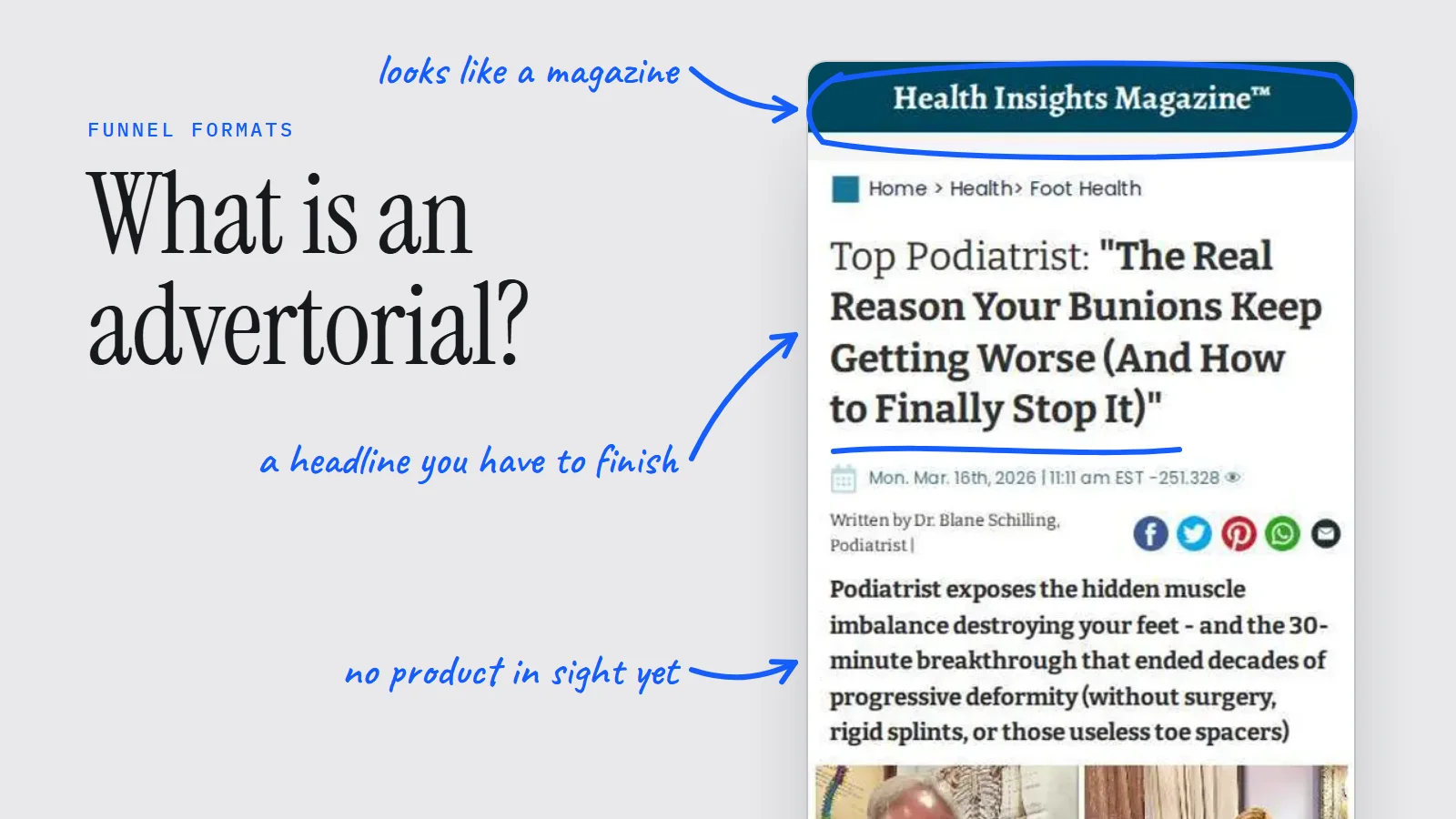
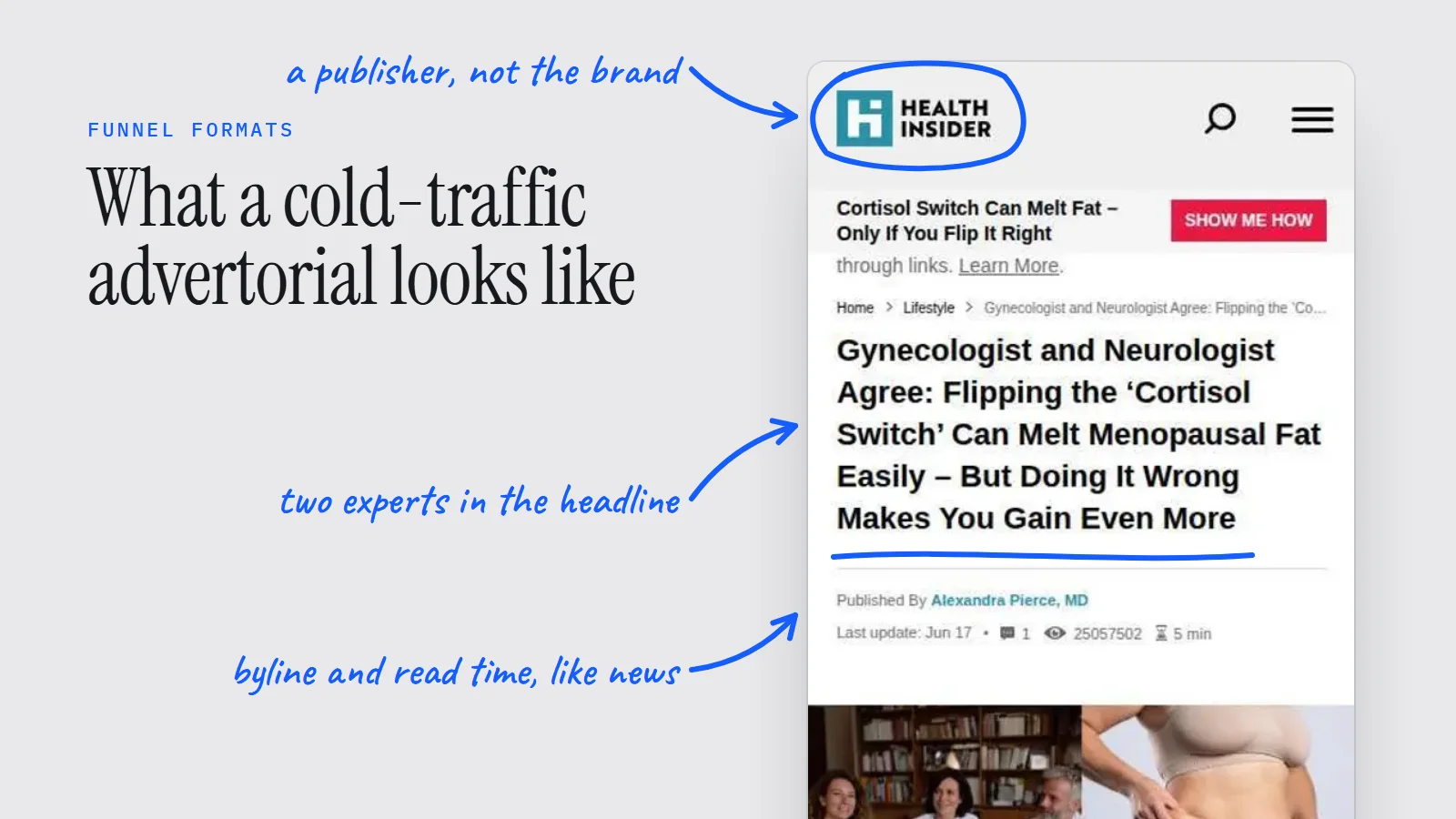
A good advertorial does not look like your shop. It looks like an article on an independent magazine site: its own masthead, a magazine typeface, a category label, an author line. This is not decoration. Cold traffic arrives defensive, and the article frame lowers the defense enough for the first paragraph to get read. The trade-off is a duty of honesty: the page must be marked as advertising, and the frame must never fabricate an authority it does not have. The frame buys attention, not permission to lie.
The headline: curiosity, not claims

The strongest advertorial headlines I have worked with make the reader need the explanation.
“Why German pharmacists keep recommending this unremarkable-looking insole” outperforms “The best insole for foot pain” in essentially every test I have run, and the reason is simple: the first one opens a loop, the second one closes it. A closed loop gives the reader permission to leave. Product name in the headline is almost always a mistake at this stage; the reader does not care about your product yet, only about their problem.
The story open
The first section is a story, usually first person, usually starting mid-scene. Not because storytelling is fashionable, but because a story is the only opening cold traffic reliably reads. Nobody who clicked out of curiosity wants a feature list. They will, however, read three paragraphs about a woman who stopped walking her dog because her knees would not cooperate, because a specific person with a specific problem is the one thing a feed-scroller cannot easily dismiss. The story’s job is recognition: the reader should think “that is me” before they think anything about you.
Agitation, then the mechanism
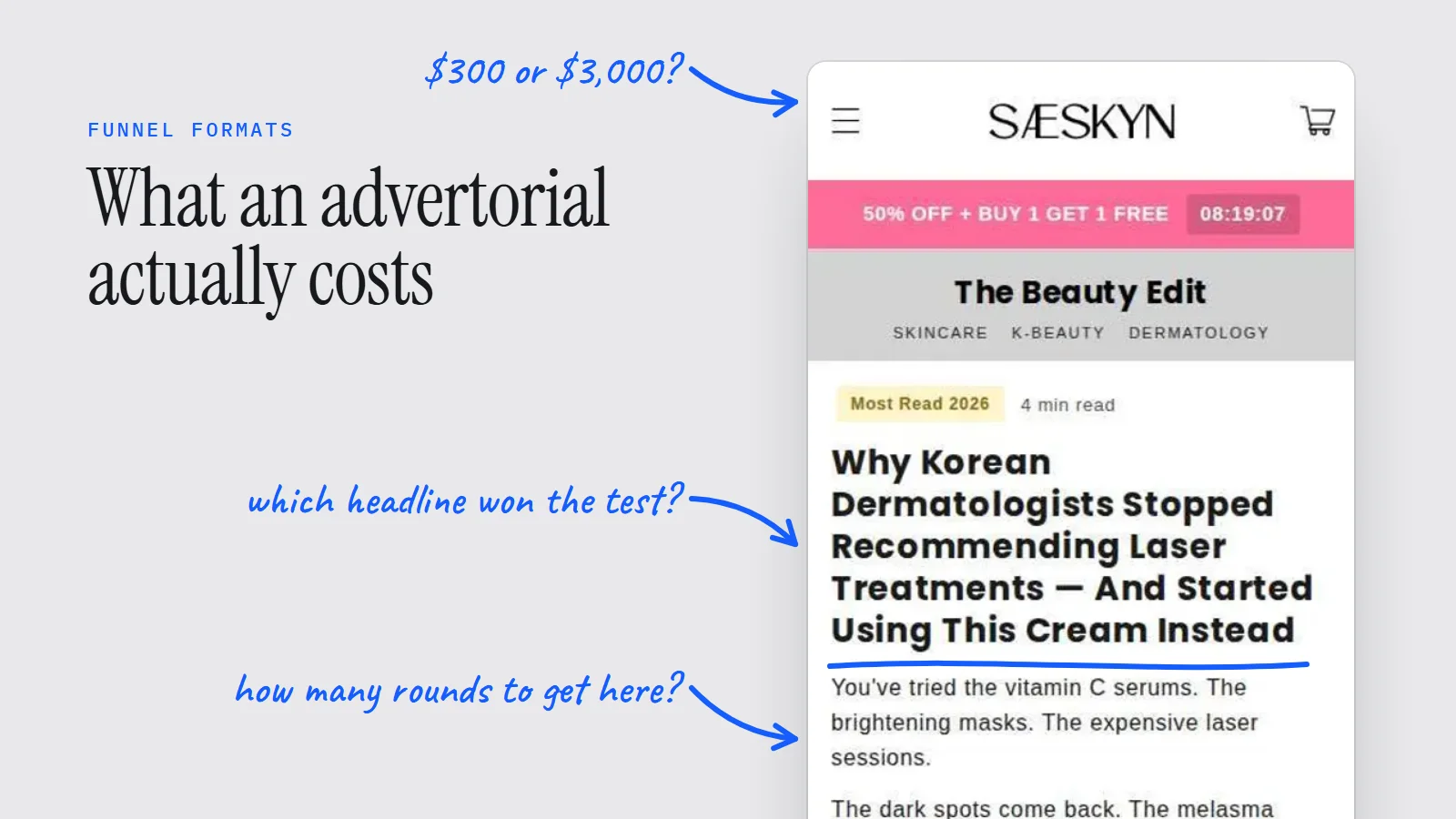
After recognition comes the part beginners skip: making the problem worse before making it better. The page walks through what the reader has already tried and why it failed. This is not cruelty, it is positioning; every failed alternative you name honestly is an objection you no longer have to answer at the offer. Then comes the pivot that carries the whole format, the mechanism: the explanation of WHY the usual solutions fail and what actually drives the problem. A good mechanism section reads like a small piece of science journalism. It is also where an advertorial earns or loses its credibility, which is why the rules we enforce matter here: no invented studies, no invented numbers. If you cannot source it, you cut it.
The product, finally
Only now, past the halfway point, does the product appear, and it appears as the logical conclusion of the mechanism rather than as a pitch. “Once you understand that X is the real cause, the question becomes how to address X daily, and that is what [product] was built for.” By this point the page has done something a product page structurally cannot: it has made the reader want the category before being asked to evaluate the brand.
Proof, offer, close
The back third is conventional and should be: real testimonials if you have them (yours, in your customers’ own words), the offer stated plainly, a guarantee if one genuinely exists, a first call to action that is soft, a final one that is direct. Price arrives late because price only makes sense to someone who already wants the thing. An FAQ at the bottom catches the stragglers.
What kills the format
Three failure modes account for most dead advertorials I have audited.
People do not read pages they do not care about; a reader whose problem you have named precisely will read two thousand words without noticing. The format needs room for the argument to breathe.
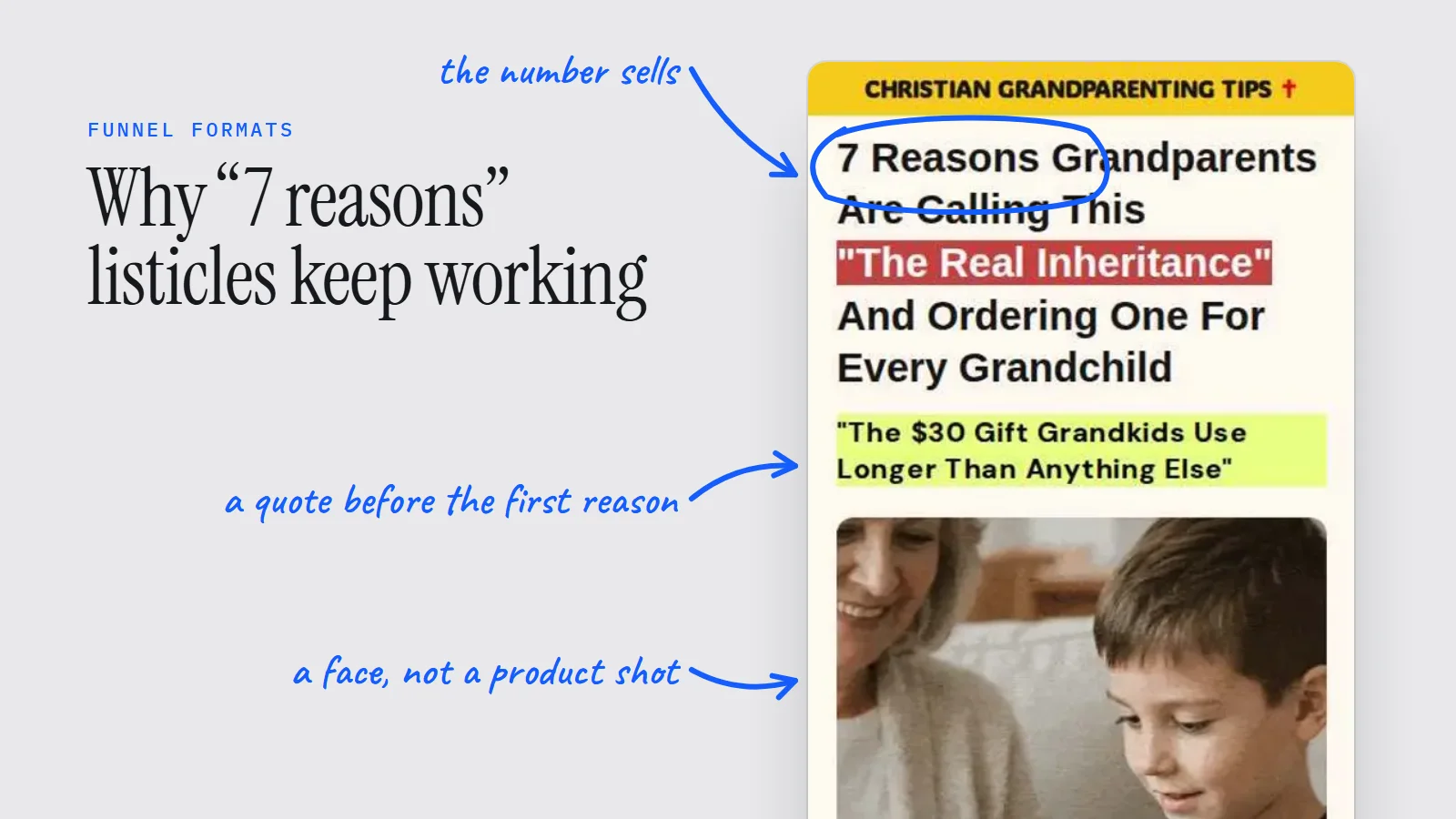
If you want to see how this structure maps to the other two formats that carry e-commerce cold traffic, the listicle builder and the comparison page builder walk through the other two, and the definitional piece on what an AI funnel builder is explains what changed about producing them.
Related: what an advertorial is and what the word commits you to, and what an advertorial costs.
FAQ
How long should an advertorial be?
Long enough for the argument to breathe. A reader whose problem you have named precisely will read two thousand words without noticing, while cutting the page to 400 words is one of the three failure modes that kill the format. Length follows the argument, not the fear that nobody reads anymore.
Where does the product appear in an advertorial?
Only past the halfway point. The story, the agitation and the mechanism come first, so the product arrives as the logical conclusion of the mechanism rather than as a pitch. A product name in the headline is almost always a mistake, because at that stage the reader only cares about their problem.
Does an advertorial have to be marked as advertising?
Yes. The page looks like an article on an independent magazine site, and that frame comes with a duty of honesty: it must be marked as advertising and must never fabricate an authority it does not have. The frame buys attention, not permission to lie.
What makes a good advertorial headline?
Curiosity, not claims. A strong headline opens a loop and makes the reader need the explanation. A headline that states the claim closes the loop and gives the reader permission to leave. To see how often supplement ads actually land on an advertorial, read our count over 83 supplement landing pages.