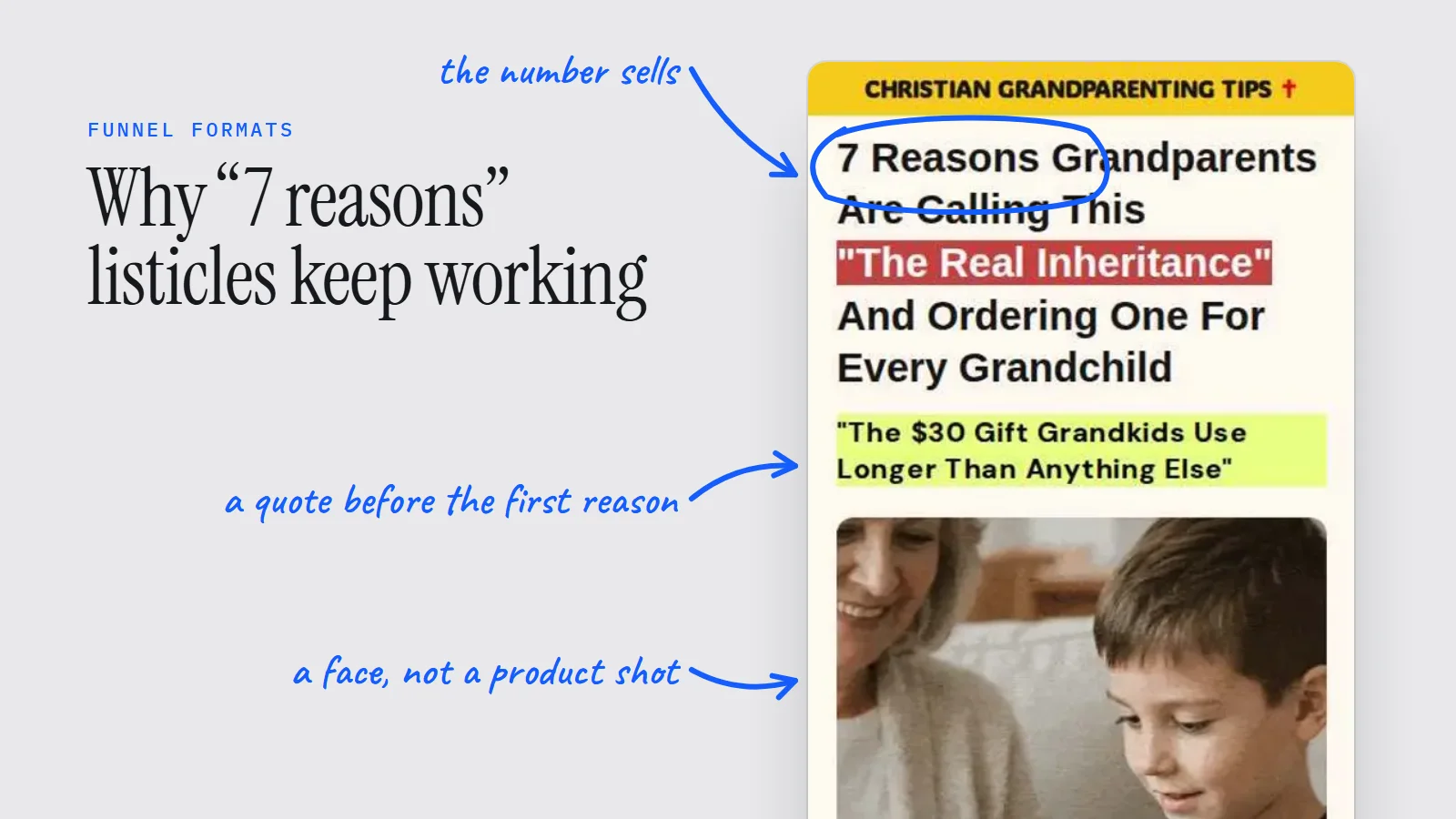
The listicle is the workhorse format of e-commerce paid traffic: an ad promises “7 reasons this coffee keeps selling out”, the click lands on a page that delivers exactly those seven reasons, and at the bottom sits the offer. It looks almost too simple to respect, which is why it keeps getting underestimated.
Brands that use it properly keep quietly outspending the ones that do not. Here is what the format actually does, mechanically, and how to build one that earns its traffic.
The promise-keeping machine
The single biggest reason listicles work is message match. The ad made a specific, countable promise, and the page keeps it, visibly, immediately, in the same words. The visitor never has to wonder whether they landed in the right place; the headline of the page is the promise of the ad. Most funnels leak the majority of their paid clicks in exactly this gap, an ad that says one thing and a page that greets the visitor with something else. The listicle closes the gap by construction, which is also why the format fails when the ad and the page are written separately: the pair is the unit, not the page.
Why numbers, of all things
A numbered list makes two promises a paragraph cannot make:
Cold traffic grants you seconds; a format that rewards partial attention beats a format that demands full attention. This is also why each item needs its own bolded claim line: the skimmer reads only those, and the claim lines alone must carry the argument.
One idea per item, strongest first
The internal discipline of a good listicle is that each item makes exactly one argument, and the first item makes the best one. Beginners save the strongest reason for last, treating the list like a fireworks show with a finale. Wrong audience: most readers never reach the finale. Item one decides whether items two through seven get read at all, so it gets the sharpest hook, often the mechanism itself. From there the classic build is:
- Mechanism first.
- Differentiation in the middle.
- Risk-reversal near the end.
- The final item flowing directly into the offer, so the close feels like item eight rather than an ambush.
The product weaves in, it does not crash in
A listicle is not seven product features with numbers in front. The best-performing pattern presents each item as a reason rooted in the reader’s problem, with the product entering as the way that reason gets satisfied.
The reader should feel they are learning something about their situation, item after item, and discover at the end that the purchase decision has quietly assembled itself.
Per-item CTAs, honestly deployed
Sprinkling a call-to-action after every second item works, but only when it is low-pressure: a plain text link, “see the current offer”, not a red flashing box after item one. The psychology of the format is the momentum of an article; a hard sell too early breaks the reading contract the numbered structure created. Soft links let the already-convinced leave early, which they will thank you for, without disturbing everyone else.
Where the listicle fits, and where it does not
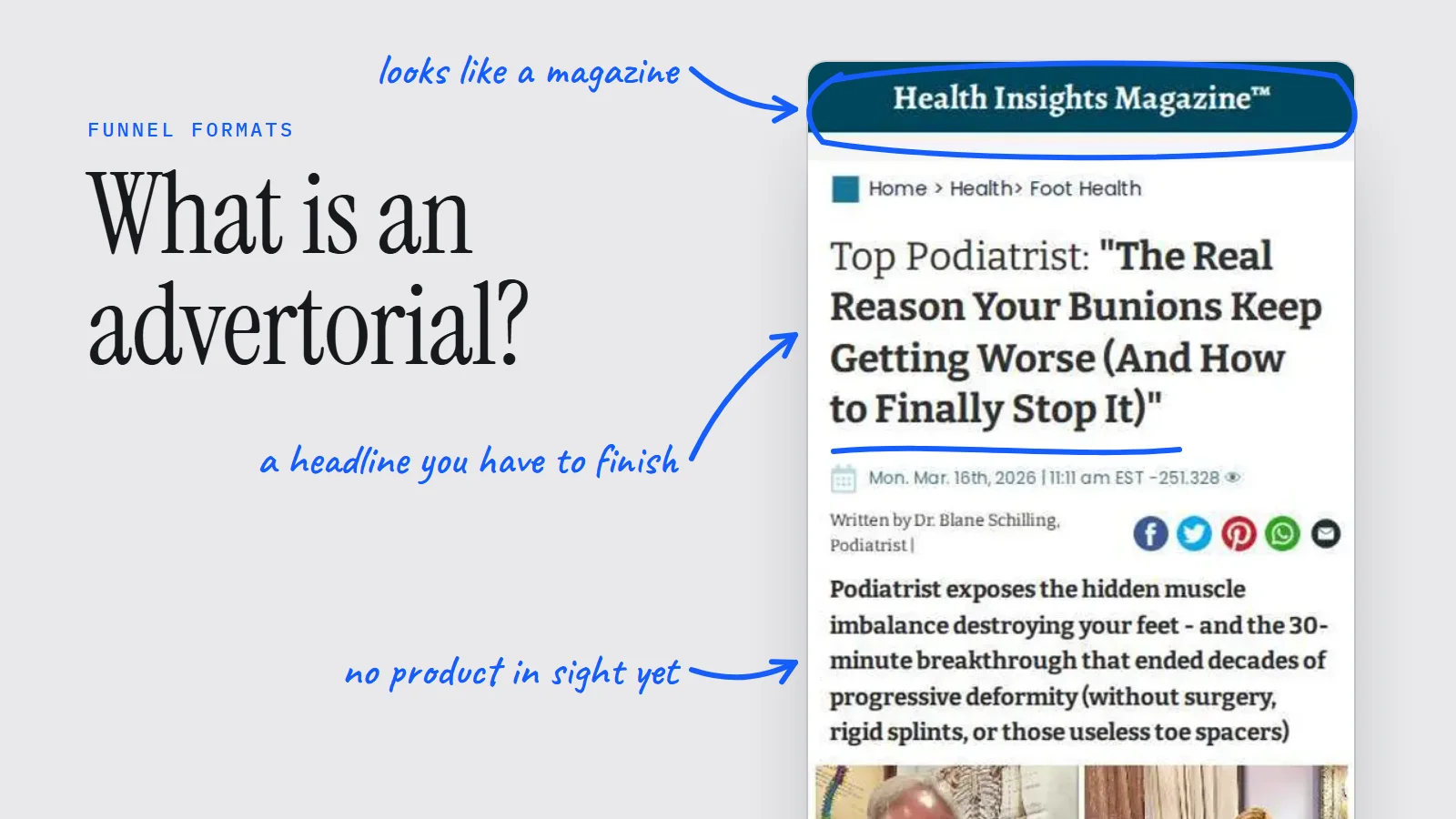
The advertorial builder and the comparison page builder show the other two formats in full.
Our listicle builder copies the structure of the listicle you give it as a reference, so pick one with exactly the anatomy above, and the honest closing note is the same one every format gets: the structure gives you the floor, not the ceiling. The ceiling is decided by whether the seven reasons are actually true, actually specific to your product, and actually matched to the ad. A numbered page full of generic praise is not a listicle; it is a product page with bullet points and worse photos.
FAQ
What is a listicle landing page?
It is a numbered page that delivers the promise an ad made. The ad promises a countable number of reasons, the page lists exactly those reasons in the same words, and the offer sits at the bottom. The ad and the page are written together, because the pair is the unit, not the page.
Why do listicles work for cold traffic?
Because of message match and bounded effort. The visitor sees the promise of the ad kept in the headline, knows the reading ends after a fixed number of items, and can skim the bolded claim lines. A format that rewards partial attention beats one that demands full attention.
Which reason should come first in a listicle?
The strongest one. Most readers never reach the end, so item one decides whether the rest gets read at all, and it gets the sharpest hook, often the mechanism itself. Differentiation follows in the middle, risk-reversal near the end, and the final item flows directly into the offer.
When is a listicle the wrong format?
When the product needs a real education first: high price points, unfamiliar mechanisms or medical skepticism. That is advertorial territory. The listicle fits impulse-friendly products, broad audiences and any offer whose appeal survives being compressed into one countable promise. For how often supplement ads land on listicles compared with product pages, see our read of 83 supplement landing pages.