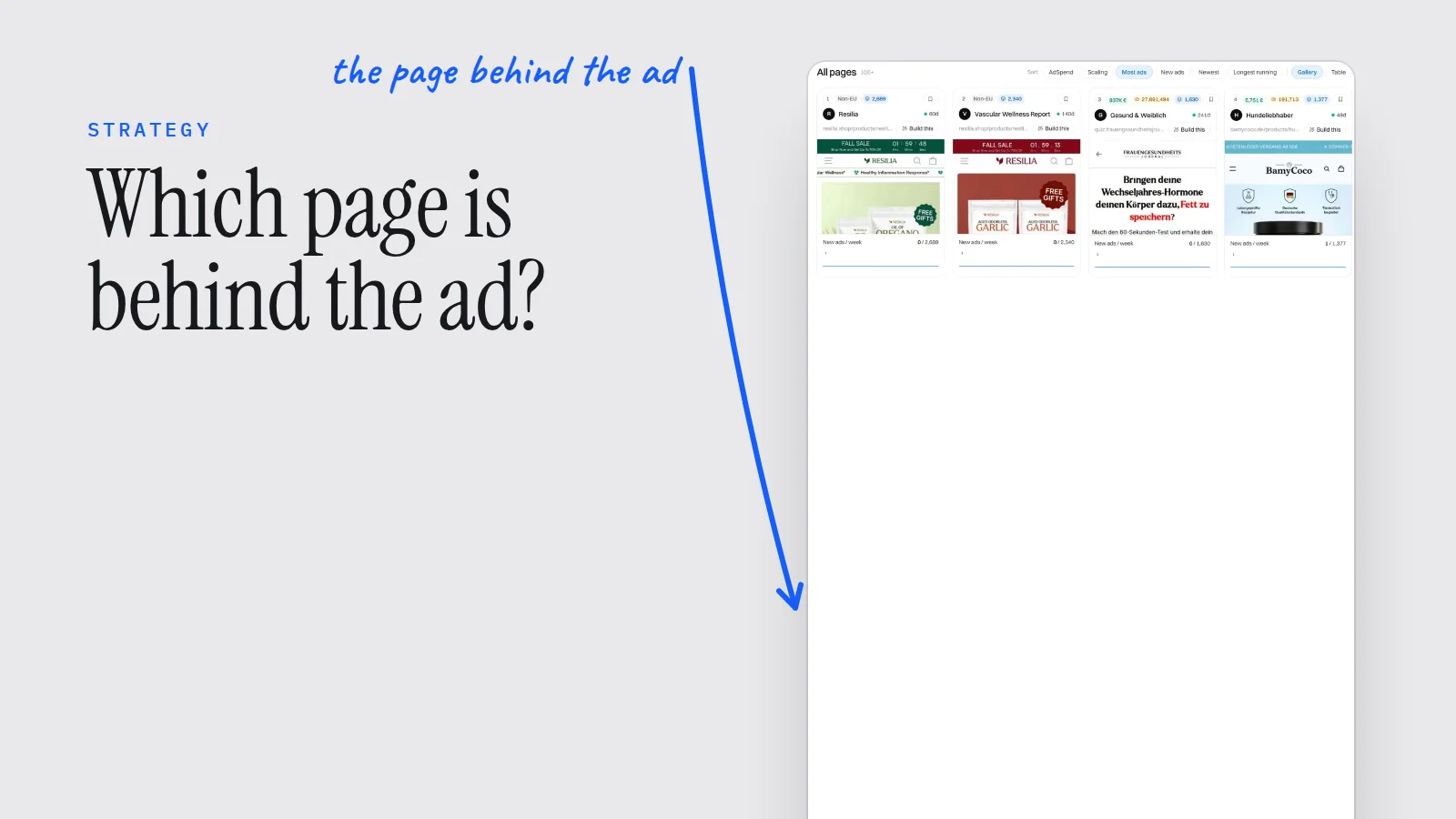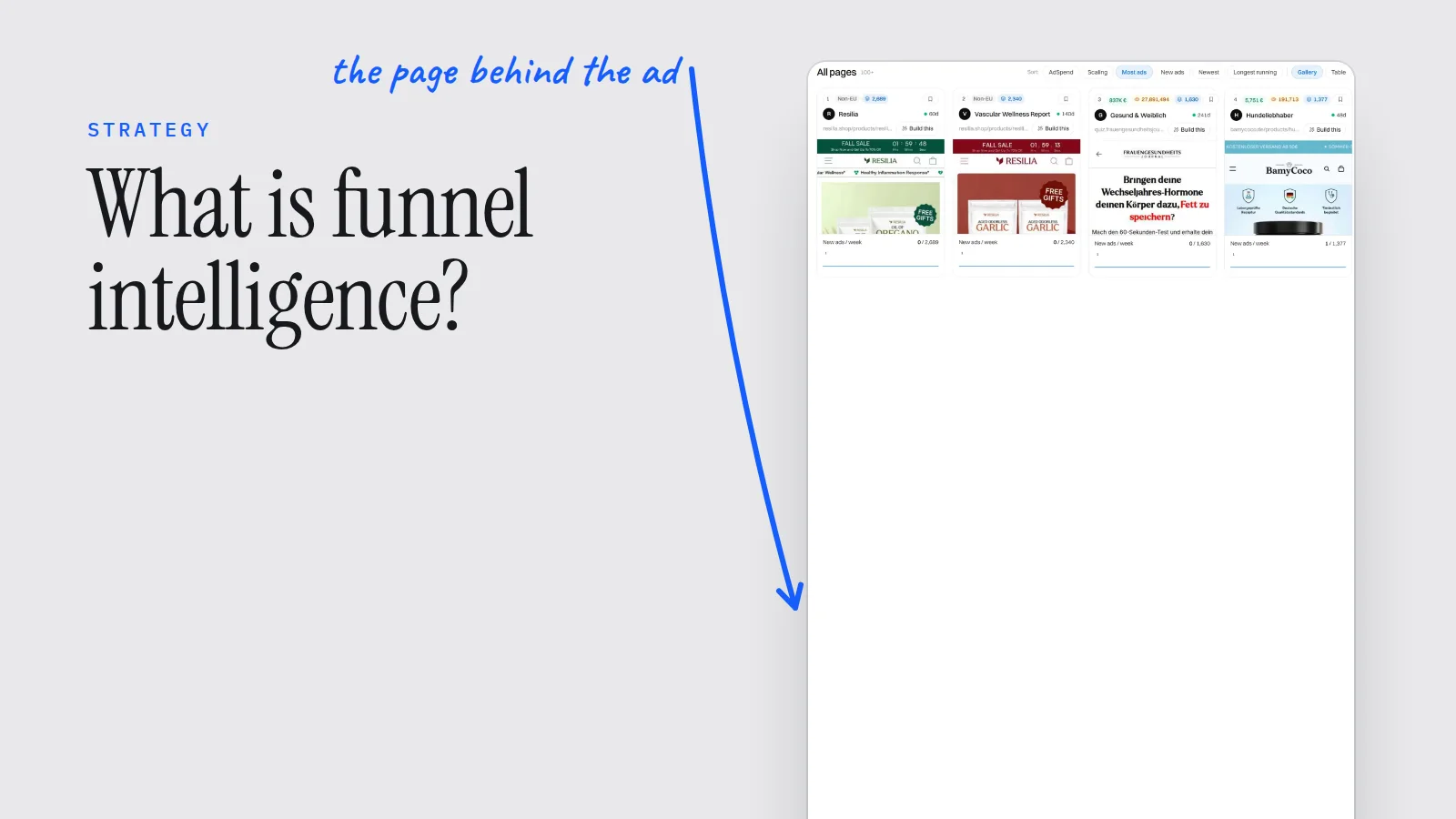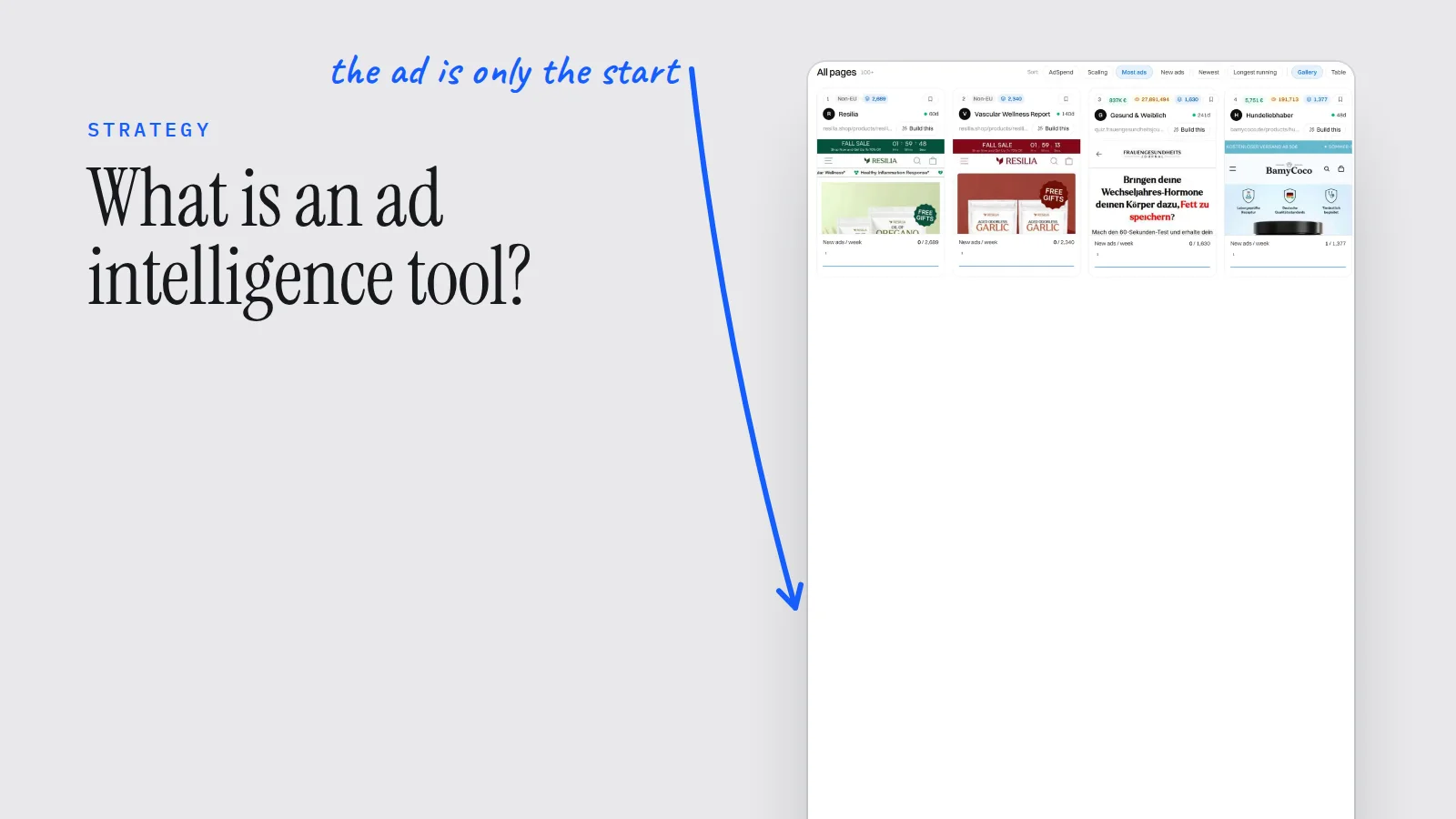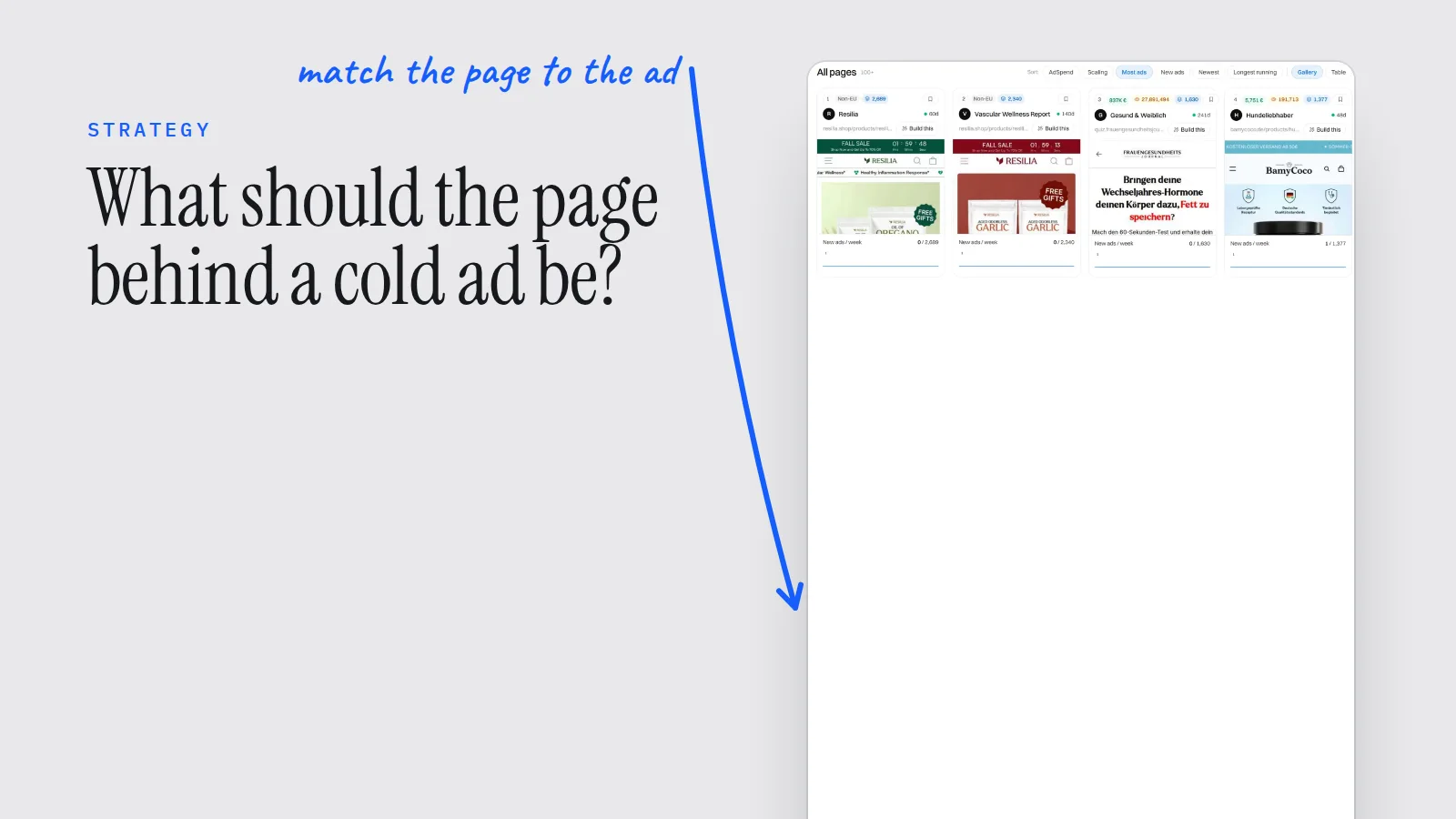
Most advice on funnel tools starts with features. I would start with the click. A person on Facebook or Instagram who taps an ad is not shopping. They were interrupted, and the page they land on has to pick up exactly where the ad stopped. I run Sophistication, which builds these pages with AI, so weigh my view accordingly. The rule below works with any tool, and you can check it against real ads yourself.
What does the page behind a cold ad have to do?
It has to carry the buyer from wherever the ad left them to the order form. Eugene Schwartz described five stages of awareness in his book Breakthrough Advertising: the buyer does not know there is a problem, knows the problem, knows the kinds of solution, knows your product, or is ready to buy at the right price. The less the buyer knows, the more the page has to explain before it asks for money.
Funnel Intel reads the same stages off the first line of each ad. That makes the rule testable: take a niche, sort the running ads by stage and look at the pages behind them.
What do real ads in one niche look like?
I read the US home niche (kitchen, bedding, decor, tools and the like) on 28 November 2026. The sample is the running ads with the most EU reach, at most 3 per shop: 37 ads from 13 shops.
Share of 37 running US home ads by awareness stage, the ads with the most EU reach, at most 3 per shop. Read on 28 November 2026 from Funnel Intel.
Only 11 of those 37 ads have a reviewed landing page, so treat what follows as a small sample. Of those 11, 8 land on a product page, 2 on a listicle and 1 on a collection. One of the listicles sits behind an ad that opens with “A Working Chef Just Ranked Every Pan. Here Is The Verdict.” The ad speaks to a buyer comparing fixes, and the page it links to is a ranked article. The ad and the page make the same promise, which is what I mean by matching the page to the ad.
Most of the sample lands on product pages, and I do not read that as proof that product pages win. Many of these ads sit at the product stage, and a product page fits a buyer who knows the product. The question is what happens to the cold ads, the 30% of the sample that opens on a problem or on nothing at all.
Which page fits which ad?
| Ad opens on | Buyer knows | Page to build |
|---|---|---|
| A story or a curiosity (unaware) | Nothing yet | Advertorial that names the problem first |
| The pain or the wish (problem) | The problem, no fix | Advertorial: story, mechanism, proof, offer |
| The fixes they tried or compare (solution) | Kinds of fix | Listicle that ranks the options |
| The brand or product (product) | The product | Product page |
| The deal, price or urgency (deal) | The product and the price | Offer page |
How each format is built is covered on the advertorial builder and listicle builder pages. The point here is the choice: the format follows the ad, never the other way round.
What should an AI funnel builder do with that rule?
Four things, in order:
- Ask for the ad first. A builder that starts from a blank page cannot match anything. It should take the ad's first line, or at least the angle, and place it on a stage.
- Pick the format from the stage. The table above, not a template gallery. If you disagree with the pick, you can override it, but the default should already be reasoned.
- Keep the ad's promise on the page. If the ad says "ranked", the headline says "ranked". A page that drops the promise loses the visitor in the first screen.
- Build the offer page behind it. The bridge page persuades, the offer page takes the order. A builder that stops at the first page leaves half the funnel to you.
The fuller definition of the category is in what an AI funnel builder is, and the case against dropping cold traffic on a theme page is in Shopify theme pages are not funnels.
When I built these pages by hand, the first question was never the layout. It was what the ad had already told the visitor.
What should the offer on the page look like?
Offers in the same niche give a feel for what buyers are shown at the end. Funnel Intel read the offers from the text of 21 of these landing pages:
Discount76%
Free shipping48%
Bundle38%
Subscription5%
Share of 21 read landing pages with each offer element, US home niche, read on 28 November 2026. Offers come from page text and can miss facts shown only in pictures.
The median discount among those pages is 50%, and the median starting price is 35.99 USD. A builder should treat the offer as an input you supply, with a discount, a bundle or free shipping where you can afford them. It should not invent one for you.
What should an AI funnel builder not build?
It should not write proof. Testimonials, numbers and photos have to be yours. It should not copy a competitor’s page, since structure is fair game and text and design are not. And it should not promise results, because the page can only change what a click is worth, not how many clicks you get. You can see how brands handle the structure in the Funnel Intel data, and the how it works page shows how Sophistication handles it.
FAQ
What is the best landing page for Facebook ads?
It depends on what the ad tells the buyer. An ad about a problem works with an advertorial, an ad about fixes with a listicle, an ad about a deal with an offer page. A product page suits buyers who already know the product.
Should cold Meta traffic go to a product page?
Sometimes. In the 11 reviewed US home pages I read, 8 were product pages, but many of those ads open on the product itself. Ads that open on a problem or a story usually need more explaining than a product page offers.
Can an AI funnel builder replace a designer?
It replaces the first draft and the iterations. You still bring the product facts, the proof and the offer, and you still decide which page goes live.
How many pages does a cold-traffic funnel need?
Two at the least: a bridge page such as an advertorial or listicle, and an offer page that takes the order. Quizzes and extra steps are tests you add later.