 Claude
 ChatGPT
 MCP
 Meta ads
I run Sophistication, and we built an MCP server for exactly this job, so the example below uses it. The workflow itself works with any server that returns ads, landing pages and offers. I compare the options in a separate article.
Why a plain chatbot is a weak strategist
Ask a chatbot without tools for “five ad angles for a magnesium supplement” and you get five tidy angles. Every founder who asks gets roughly the same five, because they come from the same old internet text. The model has no idea which of them a competitor tested last month and dropped, or which one has been running for half a year.
A human creative strategist does not start with ideas either. They start in the ad library: what is running, for how long, in how many variants, pointing at which page. An ad that a brand has kept alive for months is the best public sign that it pays. Ideas come after that, and they are tied to something observed.

The model is already good at reading, grouping and writing. What it lacks is the evidence.
What the data has to contain
A list of ads is not enough for strategy. To do the job, your assistant needs four things:
The last two are where most ad libraries stop and where most of the money is decided. Two brands can run similar ads, and the one that sends cold traffic to a listicle with a bundle offer can afford clicks the other cannot.
The workflow, step by step
- Brief it like a person. Say what you sell, the market and the funnel you run today: the ad angle and the page the ad lands on. Without this, every answer is generic.
- Read the niche before any brand. Ask who is scaling in your category, which formats and page types carry their ads and what the offers look like. This gives you the map.
- Open two or three competitors. For each: the longest-running ads, the most repeated hooks, the creative tests, and the funnel from the ad to the checkout with the offer on each page.
- Name the gap. Ask for the difference between your funnel and what the data shows. "They land on a listicle, you land on the product page" is a finding. "Be more authentic" is not.
- Ask for tests, each tied to evidence. A hook, a format, a page type or an offer to test, each with the ad or page it is based on, so you can open it and check.
A real example: reading Huel
Here is what step 3 returns for one brand. I asked for Huel, the meal replacement brand, through the Sophistication MCP.
Source: Funnel Intel through the Sophistication MCP. Data last read on 11 November 2026. A library is a sample, not Huel's full account.
This is a brand that tests in bulk. The more useful part is what it repeats. In its newest 570 ads, three opening lines carry a third of the volume:
Number of Huel's newest 570 ads that open with each line. Read on 11 November 2026.
Two of the three open on a problem (staying consistent, the busy day) and one on a comparison with other protein shakes. None opens on the product. The spoken openings of its videos follow the same habit: one ad that has run 53 days starts with “This is 40 grams of protein”, three times in a row, and others start mid-complaint: “I’m 39, I have three kids and I’m exhausted.”
How it tests: launches in bursts
A strategist also wants to know how a brand finds its winners. The weekly launch counts answer that:
New Huel ads per week over the last 12 weeks, oldest on the left. Read on 11 November 2026.
Weeks with almost nothing are followed by weeks with 60, 90 or 148 new ads. Huel does not drip ads out one by one. It starts them in batches: 53 ads on 23 October, 93 on 26 October, 48 on 31 October. Of those 48, 31 were still running eleven days later, so 17 had already been switched off. That is what a test looks like from the outside: many variants at once, the weak ones cut within days.
For a smaller brand the lesson is the method, not the volume. Ten variants of one hook started on the same day tell you more than ten ads spread over a month, because they compete under the same conditions.
Where the ads land: the funnel front to back
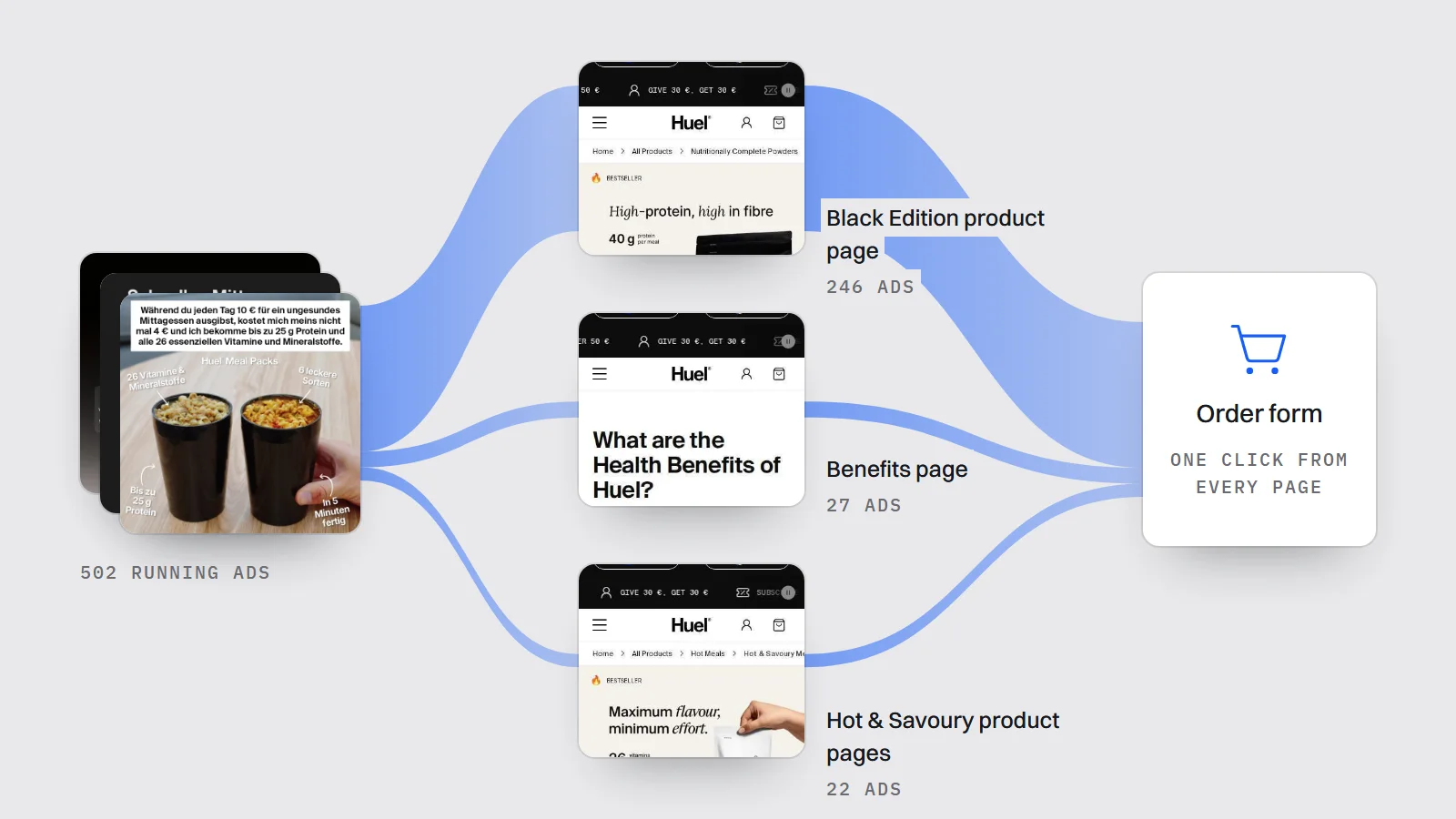
Huel’s ads, the pages they land on and the order form. Each ribbon is as wide as the number of ads behind it.
We hold 13 landing pages for Huel. Of its newest 500 ads, 246 point to the Black Edition product page (221 to the UK page, 25 to the German one), 60 to the Diet Powder product page, 27 to a benefits page and 22 to the Hot & Savoury product pages. Almost everything lands on a product page. There is no advertorial and no listicle in front of it.
From every page we followed, the order form is one click away. The offer read from the Black Edition page runs from 2.29 EUR to 49.50 EUR, it last changed on 6 November, and the main button offers 15% off for subscribing.
This is the part a list of ads cannot show you. Huel can send a stranger straight to a product page because the stranger has usually heard of Huel. The page does not have to explain what the product is or why to trust it.
The ads it never turned off
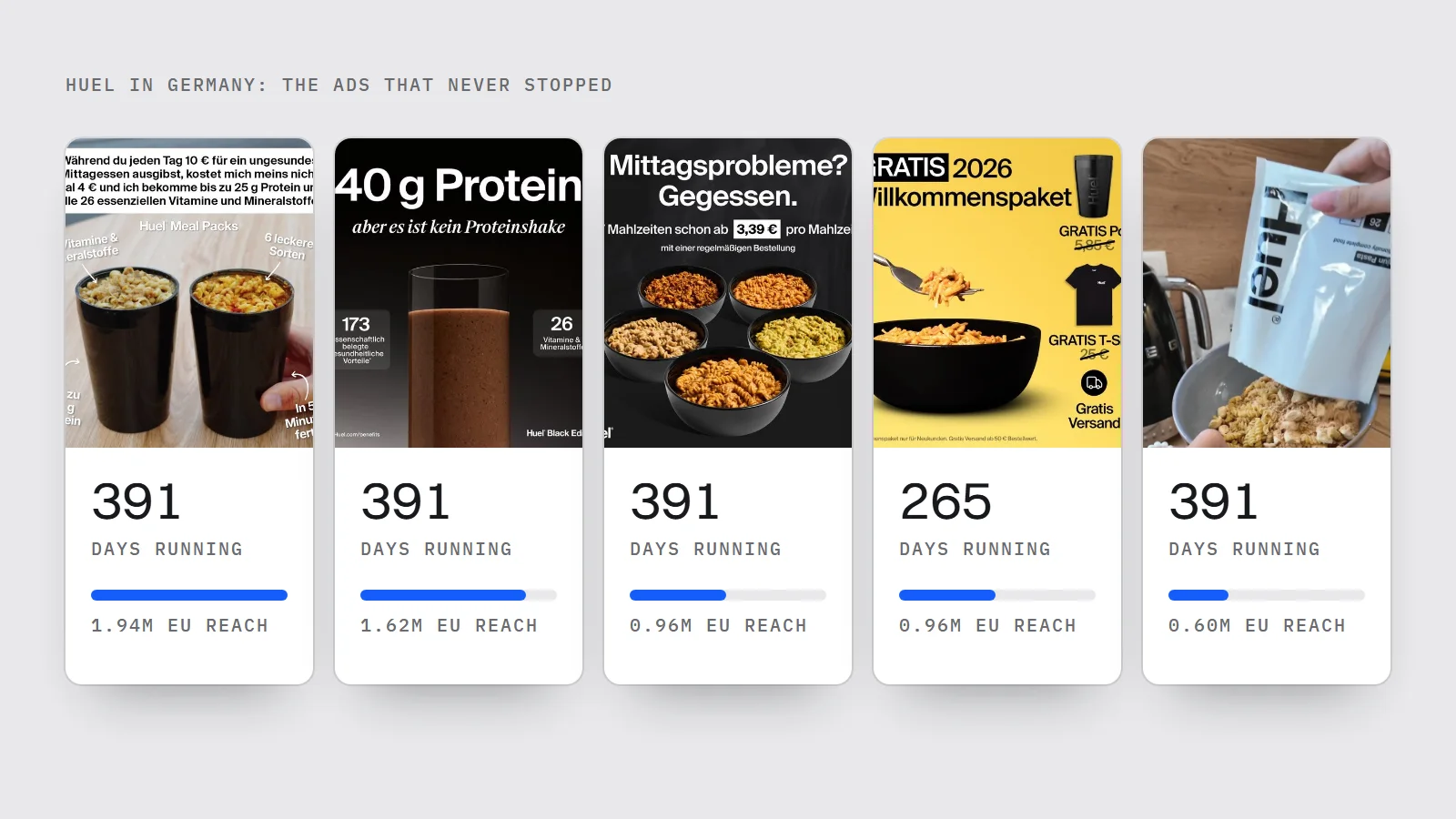
Five of Huel’s longest-running ads in Germany, with days running and Meta’s EU reach.
The other half of the picture is what survives. In Germany, the ads at the top of our ranking have all been running since 17 October 2025, which is the first day we have data for Huel, so 391 days is a minimum. The strongest one, a video with the headline “Mittagsprobleme? Gegessen.” (roughly: lunch problems, eaten), has reached 1.94 million people in the EU.
Read the long runners together and a pattern shows. They name a price per meal (3.39 EUR for the hot meals, 2.20 EUR for Black Edition) and a free gift for new customers (a T-shirt and a shaker or pot). The new English ads lead with a problem. The old German ads that never stopped lead with a concrete price and a gift. Where Meta reports the audience, 73% of the EU delivery went to men and 68% to people between 25 and 44.
What the assistant makes of it
Now the assistant has something to reason from. A fair reading: Huel’s two biggest angles are consistency in weight loss and the busy day, both aimed at a problem and not at the product, and it can send that traffic to a product page because the brand is known. A smaller competitor that copies the hooks and also lands on a product page is copying half of the system without the brand that makes it work. That is a strategic point a list of ads would never give you.
Notice what the example does not claim. It gives no spend and no revenue, because Meta publishes neither. It says “in our library”, because a library is a sample. A good assistant keeps those limits visible, and a good MCP server tells it to.
From reading to tests
The research is only worth something if it ends in tests. This is the brief I would write for a smaller meal brand from the Huel data, each test tied to what it is based on:
- A problem-first hook on consistency. Based on the line that opens 81 Huel ads. Sent to a page that explains the product first, because a brand nobody knows cannot land cold traffic on a product page the way Huel does.
- A price per meal with a gift for new customers. Based on the German ads that have run for more than a year. The offer is concrete and easy to compare with a lunch bought outside.
- One hook, ten variants, one day. Based on how Huel launches. Start them together, look again after two weeks and keep what is still worth running.
These are hypotheses. The data says what Huel does, and it cannot say what will work for another brand until that brand tests it.
Prompts that work
- "I sell [product] in [market]. My ads lead with [angle] and land on [page]. Read my niche first, then tell me what the brands that scale do differently."
- "Open [brand]. Which hooks does it repeat most, and which of its ads have run longest?"
- "Walk me through [brand]'s funnel from its strongest ad to the checkout. What is the offer on each page?"
- "Give me three concepts to test. Each one must name the ad or page from the data it is based on."
- "What did the brands I track launch this week? Group the new ads by angle."
Where this stops
Three limits are worth knowing before you rely on it.
If you want to try the workflow on your own niche, the Sophistication MCP is part of the 7-day trial, and the same data is in the app as Funnel Intel.
FAQ
Can ChatGPT or Claude replace a creative strategist?
They can do the research part quickly once they are connected to ad and funnel data: reading a niche, finding long-running ads, comparing funnels and drafting concepts tied to evidence. Judgment about the brand and the final creative decisions stay with a person.
What is an MCP server in this context?
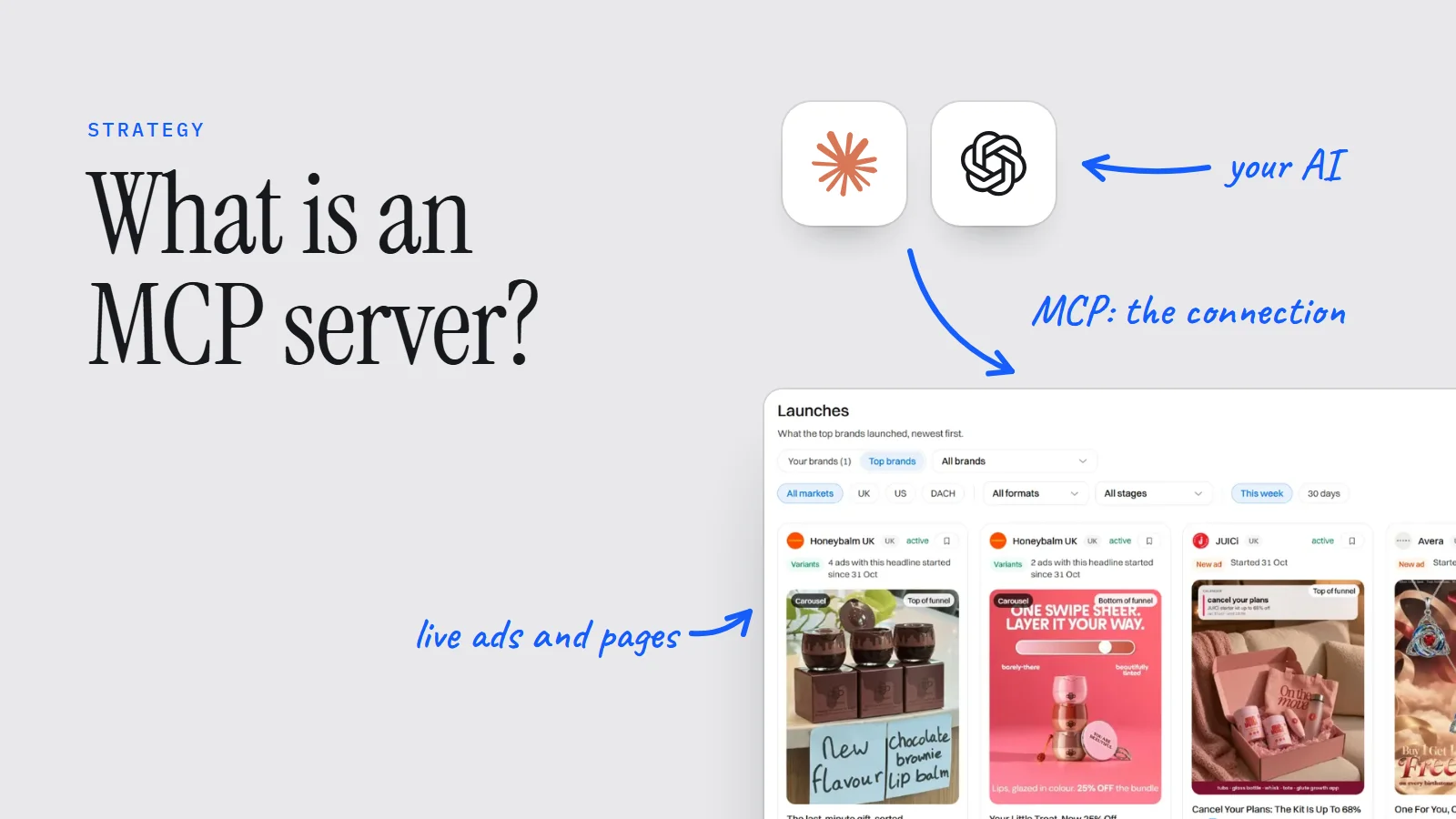
It is a connector that lets an AI assistant read an outside data source through a standard protocol. For creative strategy, that source is an ad library with the ads, landing pages and offers of other brands. The longer explanation is in what an MCP server is.
Does this work without an MCP server?
You can paste ads and pages into a chat by hand, and for one competitor that is fine. An MCP server lets the assistant search and compare hundreds of ads and pages by itself, which is what makes a niche-wide read possible.
How do I know the assistant is not making things up?
Ask for the ad or page behind every claim. A server that returns ad IDs, page addresses and read dates lets you open each one. If the assistant cannot point to a record, treat the claim as a guess.
Which data do I need for creative strategy on Meta?
Ads with run dates and variants, the landing page behind each ad with its type, and the offer on that page. Reach where Meta reports it helps. Spend and revenue are not public, so no tool can give them honestly.